


Citrus trees are often planted in smaller blocks than apple or pear orchards, and a young citrus grove in its first productive years has a far smaller canopy than the mature trees most orchard sprayers are sized for. Equipment built for a full-grown, dense orchard can be genuinely oversized for a citrus planting that is still filling in.
This guide covers what citrus orchard sprayers need to do differently, how grove size and tree age should shape the equipment choice, and a real Holsan model built for exactly this smaller scale. Whether you are searching for a citrus spraying machine, a lemon orchard sprayer, or an orange orchard sprayer, the right size of equipment matters more than matching a generic category.
It also covers the Holsan Süper Mot 1, a compact, self-powered unit built for groves that do not need — or cannot yet support — a large trailed atomizer.
Why Citrus Groves Are Often Planted Younger and Smaller Than Other Orchards
Citrus trees take several years to reach full canopy size, and many growers plant in stages or maintain smaller blocks alongside other crops rather than committing to a single large planting all at once. A newly planted or young citrus grove simply does not present the same spraying challenge as a mature, dense orchard.
That difference matters for equipment choice. A large trailed atomizer sized for a full-grown orchard can be genuinely impractical in a young or compact citrus planting, both in terms of cost and in terms of simply being more machine than the grove currently needs.
Types of Citrus Spraying Equipment by Grove Size
Backpack and Handheld Sprayers: Suited to a handful of trees or home citrus growing, though slow for anything beyond a small plot.
Compact Motorized Sprayers: Self-powered, wheelbarrow-style units that bridge the gap between handheld equipment and a full trailed atomizer, well suited to young or smaller citrus blocks.
Trailed Turbo Atomizers: The right choice once a citrus grove matures into a larger, denser planting comparable to a full orchard.
Matching the equipment to the grove’s actual current size, rather than its eventual mature size, avoids paying for capacity that will not be used for years.

What Makes a Lemon or Orange Orchard Sprayer Effective
Right-Sized Tank: A smaller tank that matches the grove’s actual coverage area means fewer wasted trips and less idle capacity.
Independent Power: A self-powered unit does not require tying up a tractor for a task that may only take a fraction of a workday on a small citrus block.
Maneuverability: Citrus groves, especially younger ones, often have tighter access between rows than a mature orchard, favoring a more compact machine.
Reliable Pump Pressure: Even a compact sprayer needs a consistent 0-50 bar pressure range to treat citrus effectively through different growth stages.
Matching a Citrus Spraying Machine to Grove Age and Density
A newly planted citrus grove, still several years from full canopy, is usually best served by a compact, self-powered sprayer rather than a large trailed unit sized for trees that do not exist yet. As the grove matures and canopy density increases, the equipment need genuinely changes.
Growers who plan to expand often start with a compact unit that handles the current grove size, then add a larger trailed atomizer once the planting reaches a scale that justifies it — rather than buying for the eventual size from day one.
Spotlight: Holsan Süper Mot 1
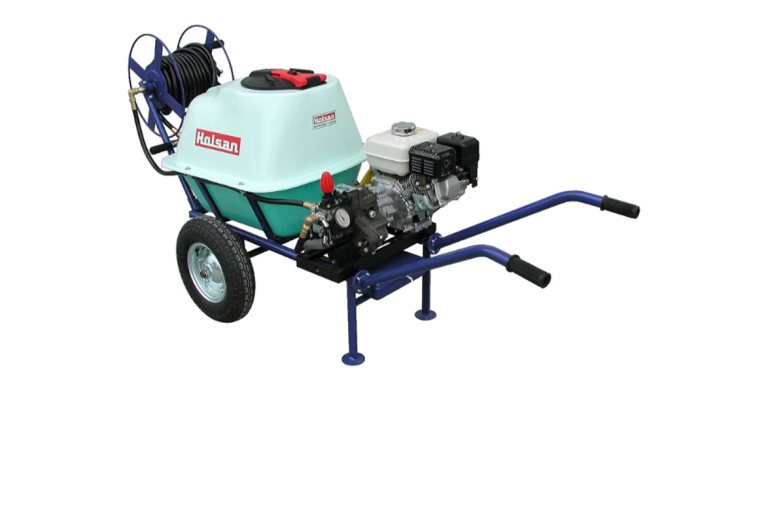
The Holsan Süper Mot 1 – 100 LT wheelbarrow-style sprayer is built for exactly this kind of smaller-scale, self-powered use. Its 100 liter anti-corrosive fiberglass tank includes a strainer, level indicator, suction filter, and drain valve — a complete, properly built tank despite its compact size.
Power comes from a Honda GX160 5.5 hp four-stroke engine driving an Imovilli PM33 high-pressure 3-diaphragm pump that delivers 34 liters per minute at an adjustable 0-50 bar, the same reliable pressure range used across Holsan’s larger equipment. The steel chassis rides on two 4.00×8, 4-ply balloon tires for easy maneuvering between young citrus rows.
It comes equipped with one spray gun, a 15-meter high-pressure hose, and a 50-meter capacity hose reel, delivering an 8 to 12 meter range. At 750 x 2,035 x 990 mm and just 86 kg, the Süper Mot 1 is genuinely sized for a young or compact citrus grove rather than scaled down from equipment built for something larger.
Maintenance for Smaller, Motorized Citrus Equipment
Service the Engine on Schedule: A gasoline-powered sprayer needs its own engine maintenance — oil changes, air filter checks — separate from the pump itself.
Rinse the Tank After Every Use: Citrus applications are often frequent during active growth periods, so residue buildup happens faster without consistent rinsing.
Check Tire Pressure Regularly: Since the unit is moved by hand or towed short distances between rows, proper tire pressure keeps it easy to maneuver in tighter young-grove spacing.
Conclusion
Choosing between citrus orchard sprayers comes down to matching equipment to the grove’s actual current size and age, not its eventual mature footprint. A right-sized machine covers a young or compact planting more efficiently than an oversized one ever could.
A citrus spraying machine scaled appropriately to the grove, maintained through each growing season, protects a crop that often represents years of investment before it reaches full production.