



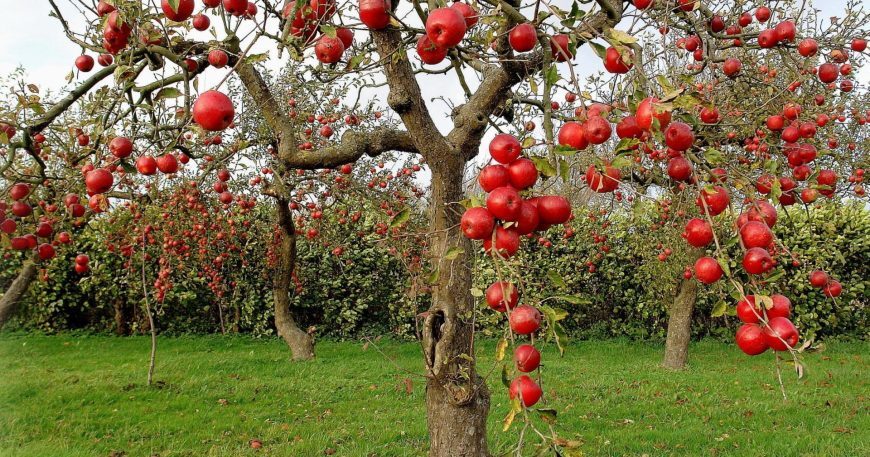
A fruit tree is a very different spraying target from a row of vegetables. The canopy is tall, the foliage is dense, and the fruit itself sits in exactly the places a low, flat spray pattern tends to miss. That is why choosing the right equipment for orchard care starts with understanding the tree, not the machine.
This guide looks at what fruit tree sprayers actually need to do, how the main types of tree spraying equipment differ, and what to look for when comparing options. Whether you are searching for the best sprayer for fruit trees or simply a dependable sprayer for fruit trees in a mid-size orchard, the deciding factors are reach, mobility, and pump performance rather than tank size alone.
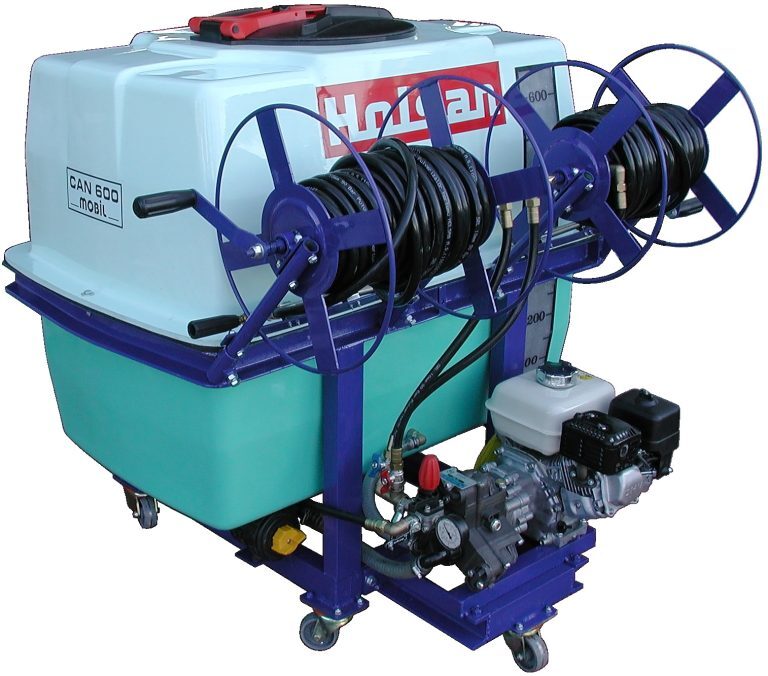
It also includes a real Holsan model, the CAN 600 Mobil, designed for exactly this kind of work: a self-powered unit that can be mounted on a pickup or a tractor and taken to the trees rather than the other way around.
What Fruit Tree Sprayers Need to Do Differently
Fruit trees have two problems most field crops do not: height and density. Spray has to travel upward and inward through branches, and it has to reach the underside of leaves where many pests actually live. A sprayer that only covers what is directly in front of it will leave the interior of the canopy largely untreated.
Timing adds another layer. Dormant, bloom, and post-bloom applications each have different requirements, so the equipment needs enough pressure range and adjustability to handle a heavy dormant spray one week and a delicate bloom-time application the next.
Weather matters just as much as timing. Spraying in wind or in the heat of midday wastes product through drift and evaporation, so a sprayer that is quick to set up and easy to move lets a grower take advantage of the short calm windows early in the morning or late in the day.
Types of Tree Spraying Equipment
Backpack and Handheld Sprayers: Practical for a handful of trees or a home orchard, but tiring and slow on anything larger.
Engine-Driven Sprayers With Hose and Gun: A pump and engine on a mountable frame, delivering high-pressure spray through a long hose. This is the most flexible option for scattered trees and mid-size orchards.
Turbo Atomizers: Airflow-driven machines towed or mounted on a tractor, best suited to dense, regular planting where a tractor can drive between rows.
Most small and mid-size growers end up choosing between the second and third type, depending on whether their trees are laid out in tractor-friendly rows.
There is no single correct answer here. A grower with a compact block of irregularly spaced trees will be better served by a mobile hose-and-gun unit, while a grower with long, straight rows will find a tractor-drawn machine faster and less tiring over a full season.
What Makes the Best Sprayer for Fruit Trees
Reach: A hose-and-gun system with a long high-pressure hose lets an operator direct spray precisely into a tall canopy, which matters more than raw tank capacity.
Adjustable Pressure: A pump that adjusts from low to high pressure covers everything from a delicate spring application to a full dormant spray.
Independent Power: A dedicated engine keeps the sprayer independent from the tractor, useful when trees are scattered or the terrain is uneven.
Corrosion-Resistant Tank: Repeated exposure to agricultural chemicals wears down poor materials quickly, so a fiberglass tank with a proper strainer and level indicator earns its cost.
Two-Operator Capability: Being able to run two guns at once cuts the time needed to cover a block in half, which becomes valuable when the spray window is short.
Choosing a Sprayer for Fruit Trees by Orchard Size
For a home orchard or a few dozen trees, a small pump with a hose is usually sufficient. For a small commercial orchard, a self-powered sprayer with a 400 to 600 liter tank strikes a good balance between capacity and portability, since it can be carried on a pickup or three-point hitch and moved between blocks.
Large, regular plantings are a different story: at that scale a tractor-drawn turbo atomizer covers far more ground per hour, and the added cost pays for itself in labor saved across the season.
Whatever the scale, it helps to walk the orchard before buying: row spacing, slope, gate width, and where the water source sits often narrow the practical choices far more than a spec sheet does.
Spotlight: Holsan CAN 600 Mobil
The Holsan CAN 600 Mobil 600 LT (Fuel Engine) is a mounted-type sprayer built for exactly this kind of work. Its 600 liter anti-corrosive fiberglass tank includes a hydraulic mixer, lockable lid, nybolt strainer, level indicator, and drain valve, so the mix stays consistent from the first tree to the last.
Power comes from a Honda GX160 5.5 hp four-stroke engine driving an Imovilli PM33 high-pressure 3-diaphragm pump that delivers 34 liters per minute at an adjustable 0-50 bar. The steel chassis can be mounted on a pickup truck or attached to a tractor at three mounting points, which makes it easy to move between orchard blocks.
The unit comes equipped with two spraying guns, two 15-meter high-pressure hoses, and two 50-meter hose reels, allowing two operators to work at once or one operator to reach deep into a tall canopy. At 1,200 x 1,270 x 1,280 mm and 191 kg, it stays compact enough for tight orchard access while still carrying a serious volume of spray.
Timing and Maintenance Tips
Flush After Every Use: Rinse the tank, pump, and hoses with clean water after each application so chemical residue does not clog the gun or corrode fittings.
Check the Engine and Pump Before the Season: Change the engine oil, inspect the diaphragms, and confirm the pressure range before the first application of the year.
Store Under Cover: Keeping the unit dry and out of direct sun through the off-season protects hoses, seals, and the fiberglass tank from premature aging.
Replace Wear Parts on Schedule: Gun seals, hose ends, and pump diaphragms are consumables. Swapping them before they fail is cheaper than losing a spray window to a mid-season breakdown.
Conclusion
The right equipment for fruit trees is the one that matches your orchard’s layout, not simply the largest or the cheapest option. Reach into the canopy, pressure adjustability, and the ability to move between blocks matter more in daily use than headline specifications.
A well-built, self-powered sprayer that can be carried to where the trees are, and maintained properly through the season, is one of the most practical investments a fruit grower can make.
