


Orchards and vineyards put very different demands on spraying equipment than open field crops do. Dense, vertical canopies need airflow that can actually push chemical up through the leaves, not just a wide flat spray pattern, which is exactly why orchard sprayers exist as their own category of equipment rather than a variant of a general field sprayer.
This guide covers what actually separates orchard sprayers from field equipment, the features that matter most in one, and a real Holsan model built for serious orchard and vineyard coverage. Whether you call it an orchard spraying machine or orchard spray equipment, the fundamentals of choosing one stay the same: airflow, tank capacity, and build quality matched to your canopy.
Getting this choice wrong doesn’t show up immediately — it shows up as uneven coverage deep in the canopy, more repeat applications than the label calls for, and pest or disease pressure that keeps coming back in the same spots every season.
What Makes Orchard Sprayers Different From Field Sprayers
A field sprayer is built to cover a flat, open area with a wide horizontal boom, which works well for row crops but does very little for a tree or vine with dense foliage on every side. Orchard sprayers instead use a turbo fan to generate strong airflow, physically pushing the spray up through branches and leaves so the chemical reaches fruit and foliage the wind alone never would.
That airflow is the entire point of the category. Without it, a large share of the chemical applied to an orchard or vineyard would simply drift past the canopy or settle only on the outer leaves, leaving the interior of the tree effectively untreated.
This is also why a orchard sprayer’s specs sheet reads so differently from a field sprayer’s: fan diameter, nozzle count, and rpm range matter as much as tank size, sometimes more, because those are the numbers that actually determine how deep the spray reaches into the canopy.
Types of Orchard Spraying Equipment
Trailed Turbo Atomizers: towed behind a tractor, these carry large tanks and a powerful fan, suited to bigger orchard and vineyard blocks.
Tower Sprayers: use a vertical tower of directional vanes to distribute airflow evenly up and down taller canopies, common in orchards with taller trees.
Cannon and Mounted Atomizers: more compact units for smaller blocks or where maneuverability between rows matters more than raw tank capacity.
Which type fits best depends mostly on canopy height and row spacing — a tower unit earns its extra cost on tall, dense trees, while a standard trailed atomizer is often enough for lower vineyard canopies. Mixed operations growing both tall fruit trees and lower vineyard rows sometimes end up running one of each rather than compromising on a single machine.

Key Features of a Good Orchard Spraying Machine
Fan and Airflow Design: A stainless-steel fan housing with directional vanes gives more even distribution than a basic fan alone.
Nozzle Count and Layout: More nozzles arranged around the airflow path mean finer control over where the spray actually lands on the canopy.
Pump Pressure Range: A 0-50 bar adjustable pump lets you match pressure to the specific chemical and canopy density.
Tank Material: An anti-corrosive fiberglass tank with a steel wave breaker holds up far longer against repeated chemical exposure than a basic plastic tank.
Adjustable Gearbox RPM: Being able to tune fan speed to conditions — dense summer foliage versus bare winter branches — keeps the airflow matched to what the canopy actually needs that day.
Matching Orchard Spray Equipment to Canopy Size and Density
Tank capacity matters less in orchard spraying than airflow reach and nozzle coverage, since the goal is penetrating a dense canopy rather than simply covering flat ground. A 2,000 liter trailed atomizer with a strong 900mm fan will out-perform a larger tank paired with a weaker fan on tall, dense trees.
Row spacing matters just as much as tree height. Tighter rows call for a more compact, maneuverable unit, while wider-spaced blocks can accommodate the turning radius of a larger tower-type machine without losing efficiency between passes.
It’s worth walking the actual rows before buying rather than sizing purely off a catalog spec, since real-world obstacles — irrigation lines, support posts, uneven ground — often narrow the practical choice more than the canopy specs alone would suggest.
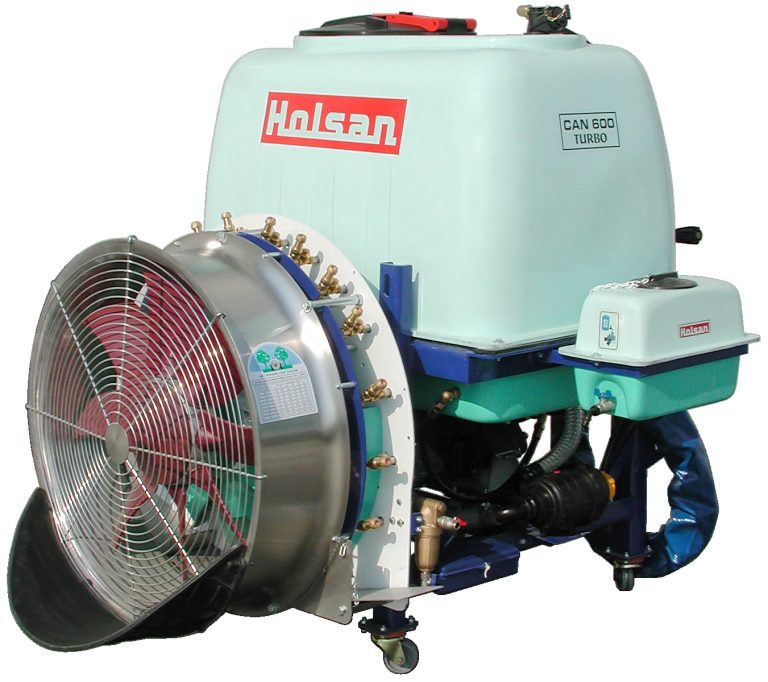
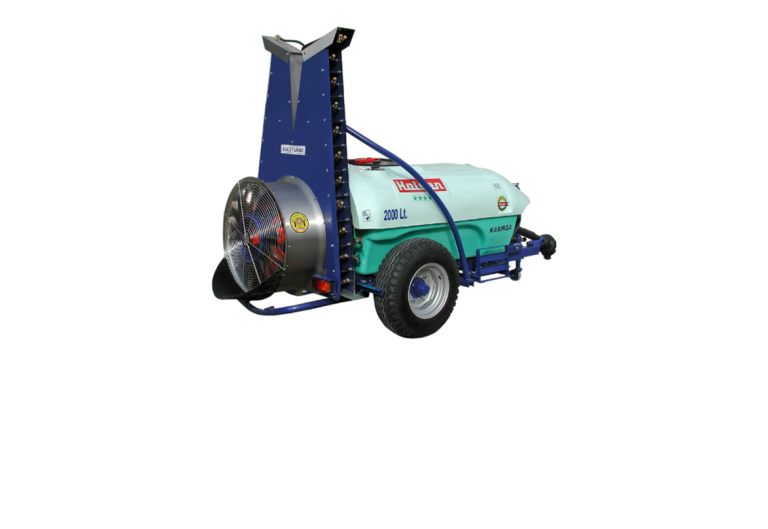
Spotlight: Holsan CAN 20 Tower — Built for Orchard Coverage
The Holsan CAN 20 Tower 2000 LT trailed turbo atomizer is purpose-built for exactly this kind of canopy penetration. Its 2,000 liter anti-corrosive fiberglass tank includes a steel wave breaker, hydraulic mixer, lockable lid, nybolt strainer, and level indicators front and side, giving consistent, well-mixed output through a long spraying session.
Power comes from an Imovilli M155 5-diaphragm pump delivering 142 liters per minute at an adjustable 0-50 bar. The tower turbo itself is the standout feature: a 900mm super-fan housed in a stainless-steel conveyor with 18 directional vanes, running through a 20-nozzle transmission adjustable from 1,950 to 2,450 rpm — built specifically to push spray evenly up through tall, dense canopies.
The chassis rides on 10.0/75-15.3 tubeless tires with a strong steel frame, steps on both sides, and a conveyor shield, and runs off an 80-degree wide-angle PTO shaft for flexible hitching. At 1,720 x 3,930 x 2,140 mm and 750 kg, the CAN 20 Tower is sized for serious orchard and vineyard blocks rather than casual use.
Maintenance Tips Specific to Orchard Sprayers
Inspect the Fan and Vanes Regularly: Airflow performance degrades quietly as vanes wear or bend, well before the pump shows any obvious problem.
Clean Nozzles After Every Use: With this many nozzles working together, even a few clogged ones noticeably uneven the spray pattern across the canopy.
Check the Gearbox and RPM Settings Each Season: The fan’s rpm range should be re-verified at the start of each season, since a drifting gearbox setting quietly reduces airflow reach over time.
Conclusion
Choosing between orchard sprayers comes down to matching airflow, nozzle layout, and tank build to your specific canopy — not simply picking the largest tank available. A machine sized correctly for your rows and tree height will out-perform a bigger, mismatched one every season.
A well-built orchard spraying machine, properly maintained, is one of the more reliable investments an orchard or vineyard operation can make, since it directly protects the yield that everything else in the season depends on.