


Modern farms depend on speed and precision to keep up with rising demand, and much of that comes down to choosing the right spraying equipment. Across open fields, orchards, and vineyards, an agricultural sprayer is the most practical way to apply pesticides, fungicides, and liquid fertilizers evenly and efficiently. With dozens of tank sizes, pump types, and mounting configurations on the market, knowing what actually matters for your operation can be confusing.
In this guide we walk through the different types of agricultural sprayer equipment, the features worth prioritizing, and a real Holsan model built for everyday farm use. Whether you call it an agricultural spray machine or an agricultural spraying machine, the fundamentals of choosing one stay the same: capacity, pressure control, and build quality.
Getting this decision wrong is rarely dramatic, but it is expensive in small, recurring ways: a tank that is too small adds hours of refill downtime over a season, an underpowered pump leaves patches of a field under-treated, and a poorly built tank shortens the working life of the whole machine. Working through the fundamentals once, before buying, is what keeps those costs from stacking up year after year.
What Is an Agricultural Sprayer and Why It Matters
An agricultural sprayer is a pressurized piece of equipment designed to apply crop protection products, fertilizers, or liquid nutrients across a field, orchard, or greenhouse in a controlled, even pattern. Compared to manual application, it lets a single operator cover far more ground in less time, while reducing the physical strain that comes with hand spraying.
Beyond speed, a well-built agricultural spraying machine helps farmers use chemicals more precisely, cutting down on waste and lowering per-acre input costs. For operations that need to stay on a tight seasonal spraying calendar, having reliable, right-sized equipment on hand is part of keeping the whole production cycle on schedule.
The category covers a wide span of equipment, from small backpack units to large trailed machines with thousand-liter tanks, and the right choice depends far more on your acreage and crop than on any single feature. That range is exactly why it helps to walk through the types and features on offer before settling on one machine.
Types of Agricultural Spraying Equipment
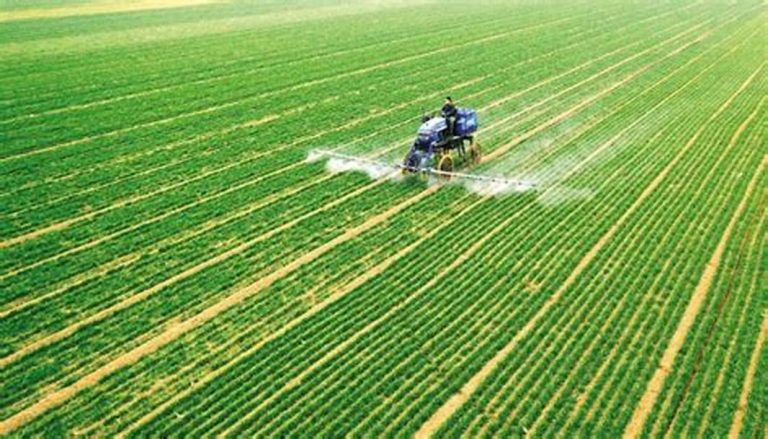
Agricultural spraying equipment comes in several configurations, each suited to a different scale of operation. Trailed sprayers are towed behind a tractor and are a common choice for mid-size to large fields, since their tanks can scale up without adding weight directly onto the tractor itself, and their independent wheelbase makes them easier to balance on uneven ground.
Tractor-Mounted Sprayers: attached directly to the tractor’s three-point hitch, these draw power from the PTO shaft and suit farms that need a compact, maneuverable setup.
Cannon and Tower Sprayers: built for orchards and vineyards, these use a powerful airflow system to push spray up and through dense canopies.
Backpack and Handheld Sprayers: practical for greenhouses, nurseries, and smaller plots where a full-size machine isn’t necessary.
Choosing between these comes down to farm size, crop type, and how often spraying needs to happen during the season. A farm running mixed crops often ends up owning more than one type, using a compact mounted unit for quick spot treatments and a larger trailed sprayer for full-field passes.
Key Features to Look for in an Agricultural Spray Machine
Tank Capacity: Small operations under 50 acres can usually manage with a 200-600 liter tank, while larger farms benefit from 1,000 liters or more to reduce refill stops.
Pump Type and Pressure Range: A diaphragm pump with an adjustable 0-50 bar range gives you the flexibility to match pressure to the crop and chemical being applied.
PTO Shaft and Drivetrain: A standard, constant-velocity PTO shaft ensures the sprayer draws power reliably from the tractor regardless of turning angle.
Build Material: A corrosion-resistant fiberglass or stainless-steel tank holds up far longer against the chemicals it carries than a lower-grade plastic alternative.
Nozzles and Spray Width: The nozzle configuration determines droplet size and coverage width, and it should be matched to the specific chemical and crop row spacing rather than left at a generic factory setting.
Matching Sprayer Capacity to Your Farm Size
Getting the tank size right is one of the most consequential decisions in choosing an agricultural sprayer, since an undersized tank means constant refill trips and an oversized one adds unnecessary weight and cost. As a general guide, small farms under 50 acres do well with 200-400 liter tanks, mid-size operations of 50-200 acres typically need 600-1,200 liters, and large farms above 200 acres benefit from tanks of 1,500 liters or more.
Crop type matters just as much as acreage. Row crops with frequent spraying cycles benefit from a larger tank that reduces how often the operator needs to stop, while orchards and vineyards, where canopy density varies, often call for a sprayer with adjustable output rather than sheer volume alone.
It’s also worth sizing the sprayer to your actual tractor, not just your field. A tank that is technically large enough for the acreage but too heavy for the tractor’s hydraulic capacity will still slow the job down and add unnecessary wear to both machines.
Spotlight: Holsan Super Mil 10A — A Dependable Agricultural Sprayer
For farms that need a capable, mid-capacity machine without the bulk of a 2,000-liter unit, the Holsan Super Mil 10A 1000 LT trailed sprayer is a practical fit. Its 1,000 liter anti-corrosive fiberglass tank includes a hydraulic mixer for even chemical distribution, a lockable lid, a nybolt strainer, and a level indicator, giving operators the visibility and control needed for consistent application.
Power comes from an Imovilli M73 high-pressure 3-diaphragm pump, delivering 70 liters per minute at an adjustable 0-50 bar, which covers most row-crop and orchard spraying needs without upgrading to a larger unit. The sprayer runs off a standard, constant-velocity PTO shaft with an adjustable tow-bar, so it hitches easily to a range of tractor sizes.
On the equipment side, it comes with two 15-meter high-pressure hoses, two spray guns, and two 50-meter capacity hose reels, giving an effective spray range of 8 to 12 meters. At 1,470 x 3,380 x 1,340 mm and 380 kg, the Super Mil 10A stays maneuverable enough for tighter field edges while still covering serious ground per tank, which is exactly the balance a mid-size operation is usually looking for.

Maintenance Tips to Extend the Life of Your Agricultural Sprayer
Rinse After Every Use: Flushing the tank, pump, and hoses with clean water after each application prevents chemical residue from clogging nozzles or corroding internal components.
Inspect the Pump Regularly: Diaphragm and piston pumps should be checked periodically for wear, since a small pressure drop early on can turn into a costly repair later.
Store It Properly: Keeping the sprayer under cover and out of direct sun during the off-season protects fiberglass tanks and rubber seals from premature aging.
Replace Wear Parts on Schedule: Nozzles, gaskets, and filters wear out well before the rest of the machine, and swapping them on schedule keeps an agricultural spraying machine performing at its rated output.

Why the Right Agricultural Sprayer Improves Farm Efficiency
Choosing the right agricultural sprayer is not just about covering ground faster — it directly shapes how efficiently a farm uses its chemicals, labor, and time during the season. Farmers who weigh tank capacity, pump performance, and build quality carefully end up with equipment that pays for itself over years of reliable use rather than becoming a recurring source of downtime.
An agricultural sprayer that is properly matched to your farm’s size and properly maintained will keep pace with the demands of a full spraying season for years. Getting the choice right at the outset is, in the end, the simplest way to protect both crop yield and long-term operating costs.